
Accessibility as the starting point
Content designed to the WCAG guidelines, with text size adjustment, a high contrast mode and support for screen readers.
MyQR
Menus, services and information you can read from a QR code, designed to accessibility standards and not simply shrunk down onto a screen.
The PDF menu you scan with your phone has become the standard, but it is a solution that only works for people who see well. Anyone with a visual impairment, anyone who does not speak the language, or anyone who simply cannot find the information they are after is left out, and nobody notices, because that person does not complain: they leave.
MyQR started with Bandiera Lilla, Italy’s accessible tourism programme, as a tool for beach clubs, and tackles exactly this: content built to be accessible, with resizable text, high contrast, compatibility with screen readers and a structure that takes you straight to the information that matters most.
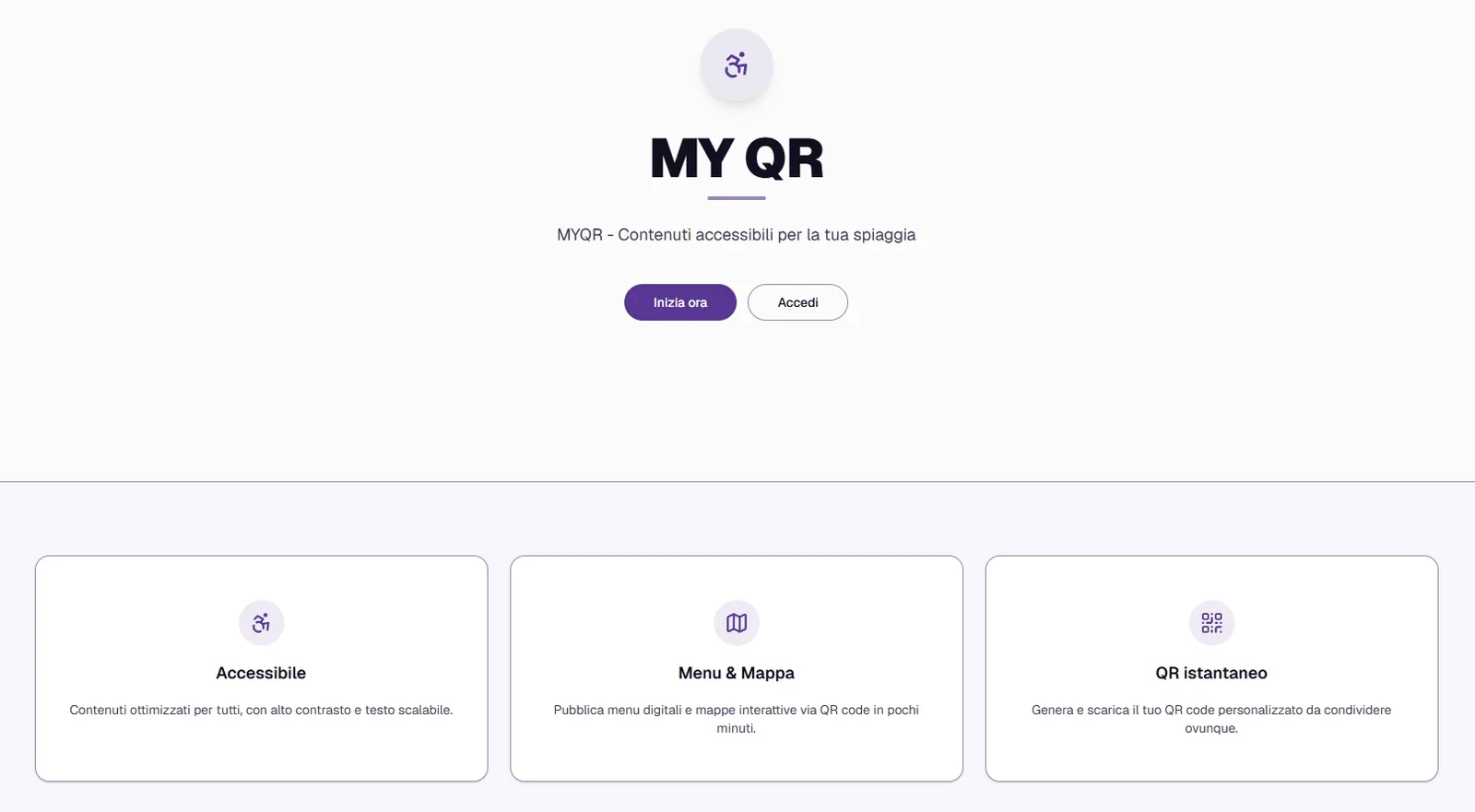
Accessible content, menus and maps published via QR code, with high contrast and scalable text.
What the customer sees when they scan.
Starters
First courses
Main courses
Desserts
Updated just now
Content designed to the WCAG guidelines, with text size adjustment, a high contrast mode and support for screen readers.
Toilets, showers, cabins, parking and access points are put at the top instead of being buried at the bottom of a page.
When a request finds no match, the system still points the person towards useful information instead of leaving them on an empty page.
A simple admin panel to update content, prices and services on your own, without calling anyone.
Born with Bandiera Lilla for beach clubs, it works anywhere there is something to read from a phone.
Support
MyQR is a digital solution for menus, maps and content accessible through a QR code, designed for restaurants, hotels, beach clubs and tourist venues.
No. It is not simply a link to a PDF. It is a system that turns content into digital pages that are clearer, more accessible, multilingual and easier to update.
It makes content easier to read, navigate and understand for everyone, including people with sight difficulties, older people, tourists and people with specific needs.
A PDF can be hard to read on a phone, poorly accessible, incompatible with screen readers, awkward to update and not well suited to people with sight difficulties.
Yes. MyQR is built with a digital accessibility approach, with attention to readability, navigation, contrast, structure and how usable the content is.
Yes. Beach clubs can use it for menus, maps, services, guest information, multilingual content and more accessible communications.
Yes. Hotels and tourist venues can use it for menus, services, internal information, maps, rules, guest communications and multilingual content.
Yes. Restaurants and bars can use it for digital menus, allergens, translations, dish descriptions, price updates and a better customer experience.
Yes. The QR code can stay the same while content, prices, photos, descriptions and categories are updated digitally.
Yes. The system can support multilingual content, which is useful for tourist venues, restaurants, hotels and businesses with international customers.
Yes. The digital menu can include allergens, dietary information, details about the food and other information that helps customers choose.
Yes. The aim is to make content more compatible with accessibility tools such as screen readers, text magnification and simplified reading.
Yes. AI can help turn disorganised content, PDFs or images into drafts that are better structured and can be edited.
Yes. The system can support turning existing materials into digital content that is better organised, more accessible and easier to update.
A digital menu can be updated, is optimised for phones, is multilingual, is more accessible and does not need reprinting every time the content changes.
No. It improves the experience for everyone: older people, tourists, users in bright sunlight, customers with allergies, people with low vision and users who prefer content that is easier to read.
Tell us the process you want to improve. We will review your request and help you find the best path.
We use one technical cookie, pcdue_consent, to remember this choice for 6 months and an identifier for this browser, which you can copy. We do not use analytics, profiling or third-party cookies. You can accept them all, refuse them or see the detail: today the non-essential categories are empty. Cookie policy
Identifier for this browser
It lives in the technical cookie. Copy it if you need to refer back to this choice. It does not follow you across the web and it is not a profiling code.
PCDUE Shield
Technical cookies stay on. The other categories are off, because this site does not use any. If we added some, we would ask for your consent again.
Identifier for this browser
It lives in the technical cookie. Copy it if you need to refer back to this choice. It does not follow you across the web and it is not a profiling code.
PCDUE Shield
These choices change the site on this browser, on every page, and on phone, tablet and desktop. They adjust text, contrast, links, spacing, animations and keyboard focus, as WCAG asks. They do not replace the accessibility already built into the site.
Text size
Contrast
Light: black text on white. Dark: light text on black.
PCDUE Shield